Project-level expense, cash-flow and supplier accounting for construction firms. Every amount is entered once, and every view reads the same ledger.
Most construction spending is still captured on paper: a site register, a diary, a bundle of vouchers, and a message thread. The numbers exist, but they sit in the wrong places, and nobody can prove which copy is right.
A lost, burnt or rain-damaged book takes the project history with it. There is nothing to check it against.
The gap between them surfaces at month end, by which time the cash has already moved.
What is owed to which supplier is rebuilt from a pile of receipts every time somebody asks.
An amount can be changed, or a page removed, with no record of who did it or what the figure was before.
Each of these is a record-keeping problem before it is an accounting problem. That is where the product starts.
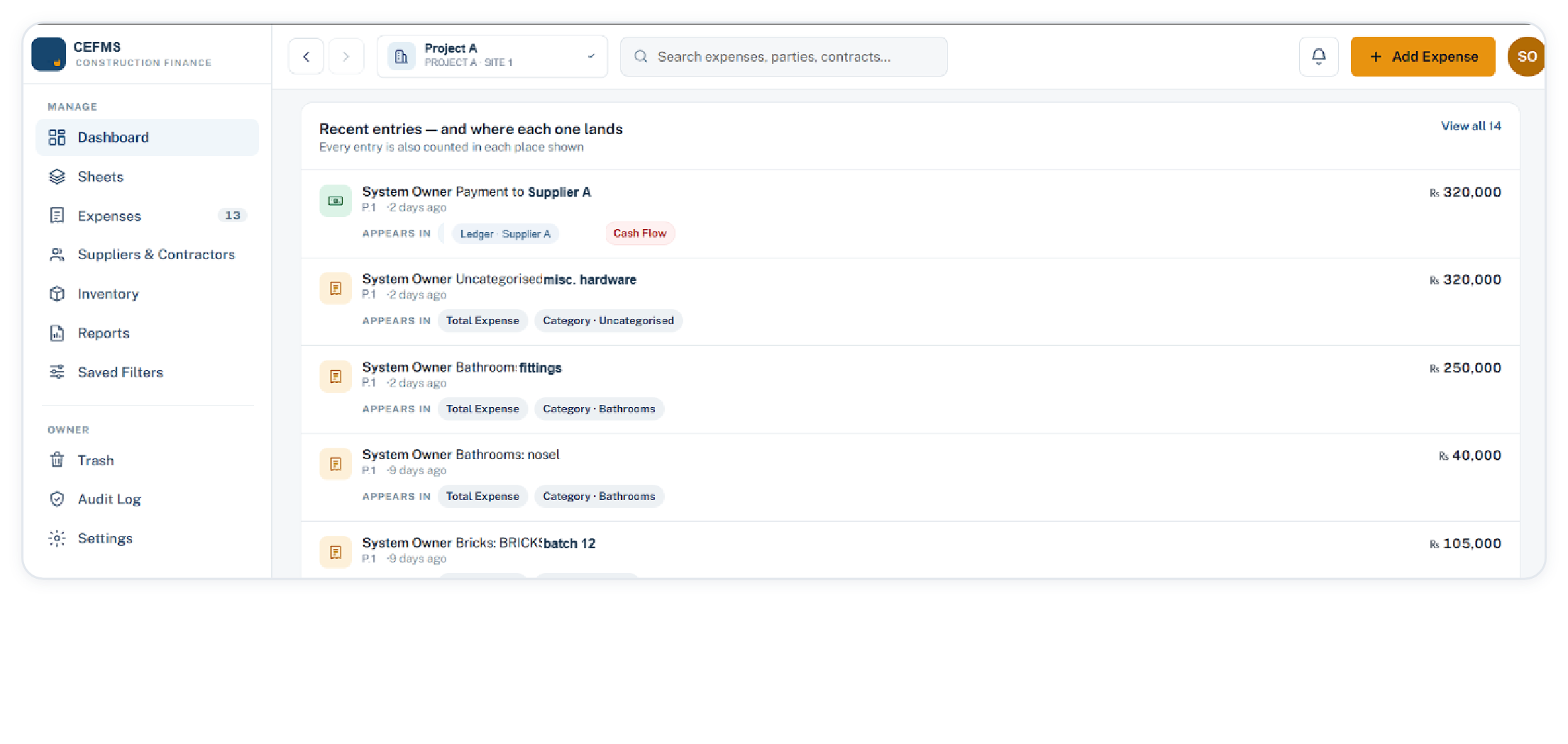
An expense is entered once, by whoever is standing in front of the supplier, against exactly one project. From that single record the project total, the category head, the party balance and the cash position all follow. There is no second book to keep in step.
An expense books a cost. What it leaves owed and what was actually paid post to the party as two separate ledger entries, so a part payment is never rounded into one figure.
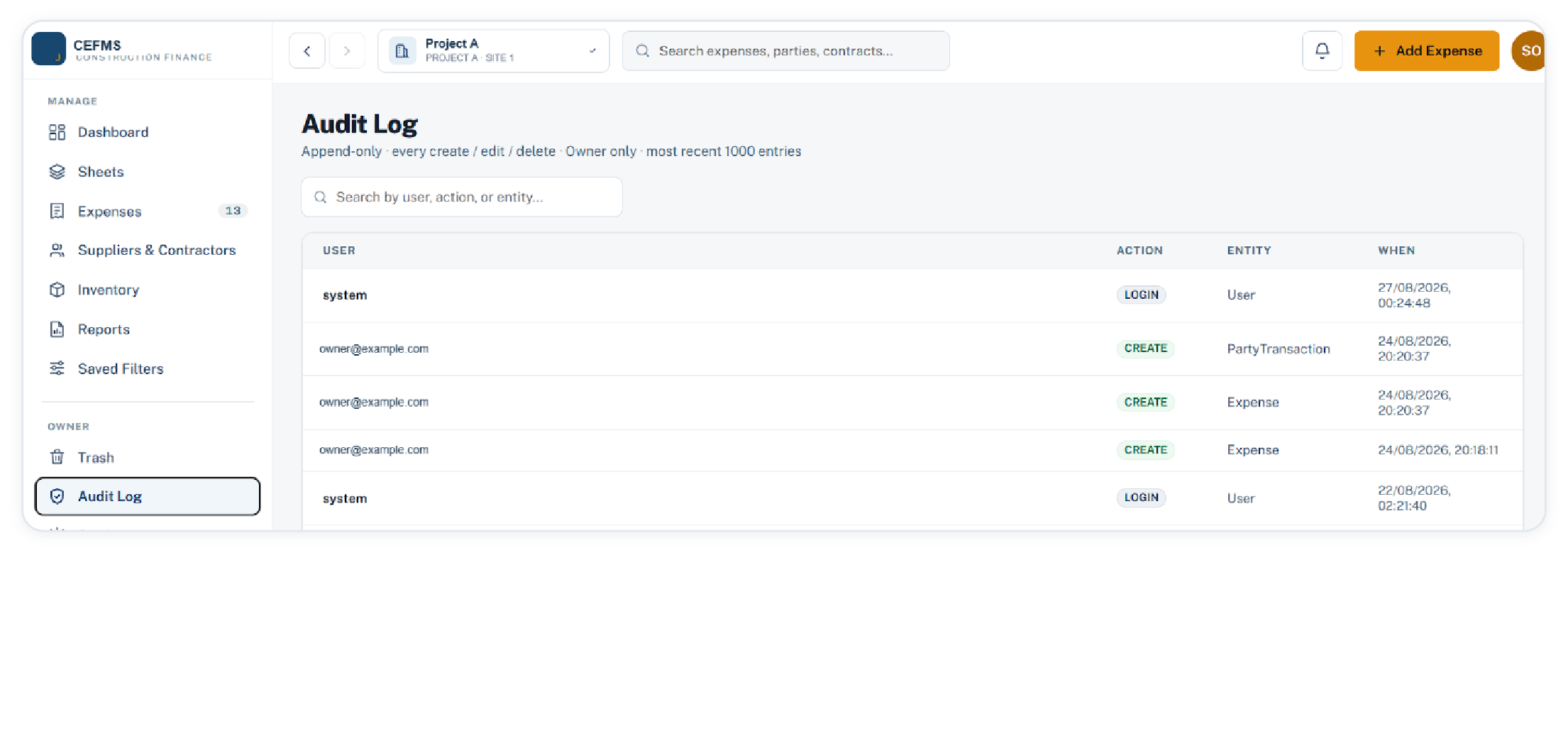
Money is never rounded. Every entry is written to the audit log with the user, the action and the time, and that log is kept in full.
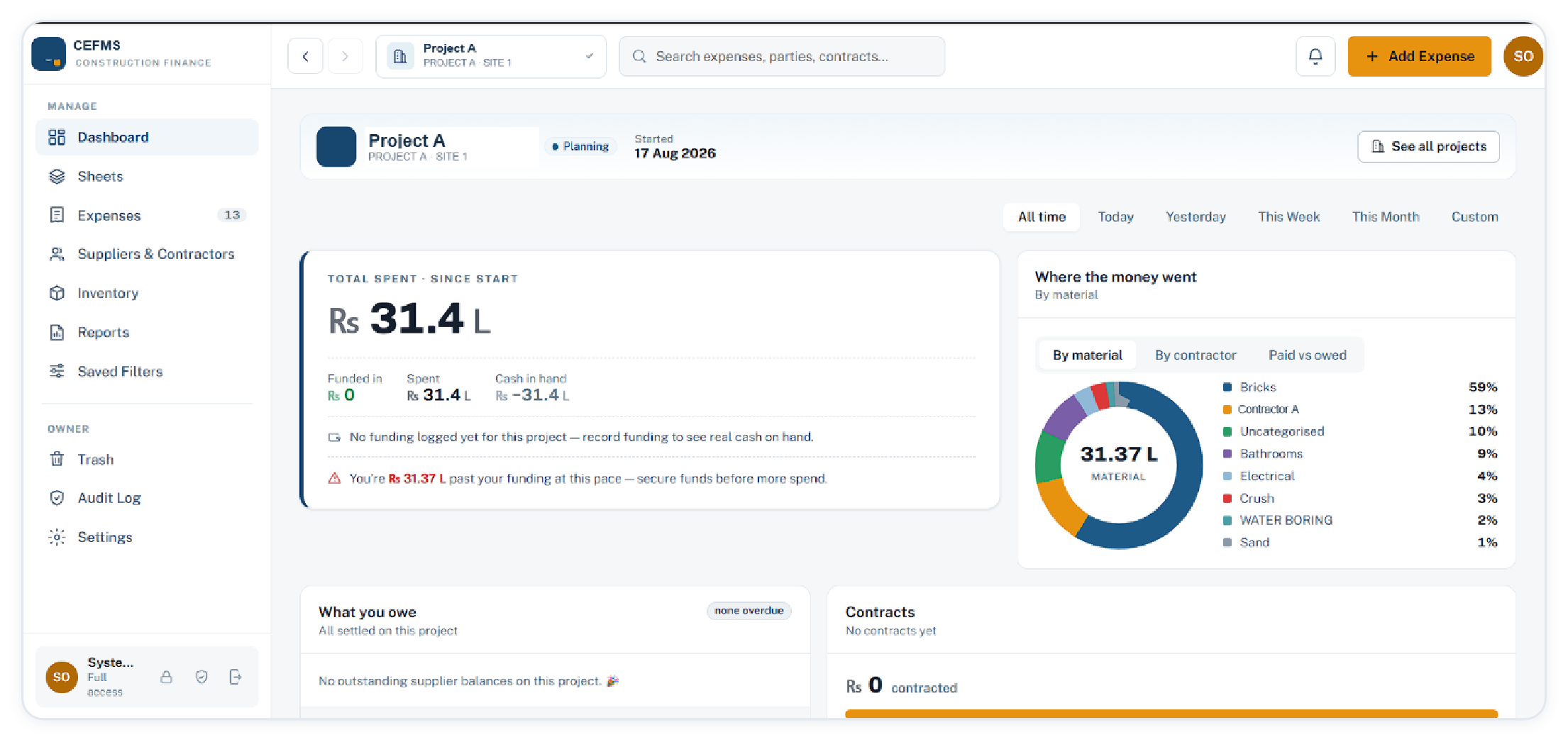
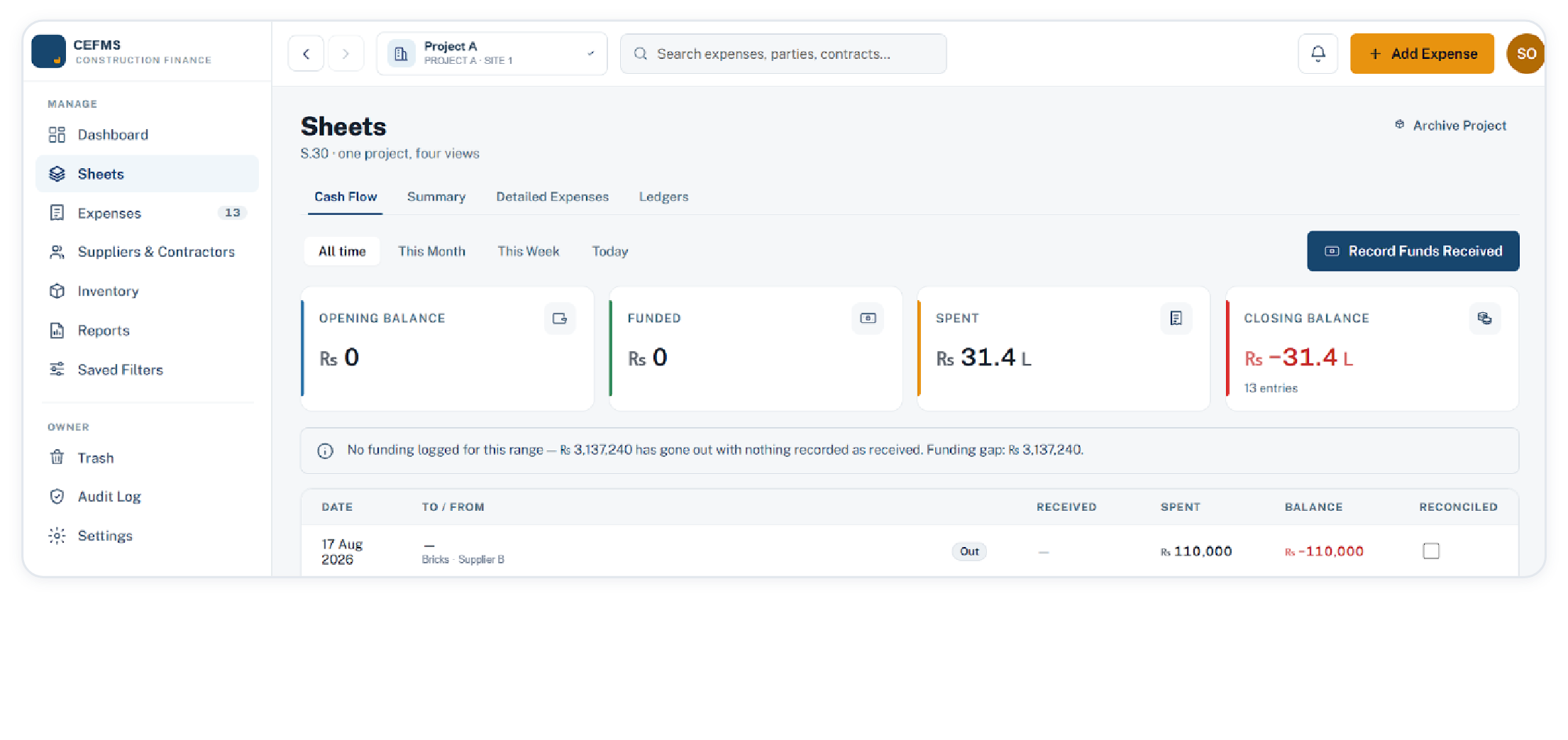
Total spent since the start, what came in against it, and what is left in hand. When spending has run ahead of recorded funding, the card says so in words and gives the figure.
Funded in, spent and cash in hand sit under the headline figure, so a negative position is visible at a glance.
The same spend read three ways: by material, by contractor, and paid against owed.
Outstanding supplier balances and contract value for the project, with an overdue count beside them.
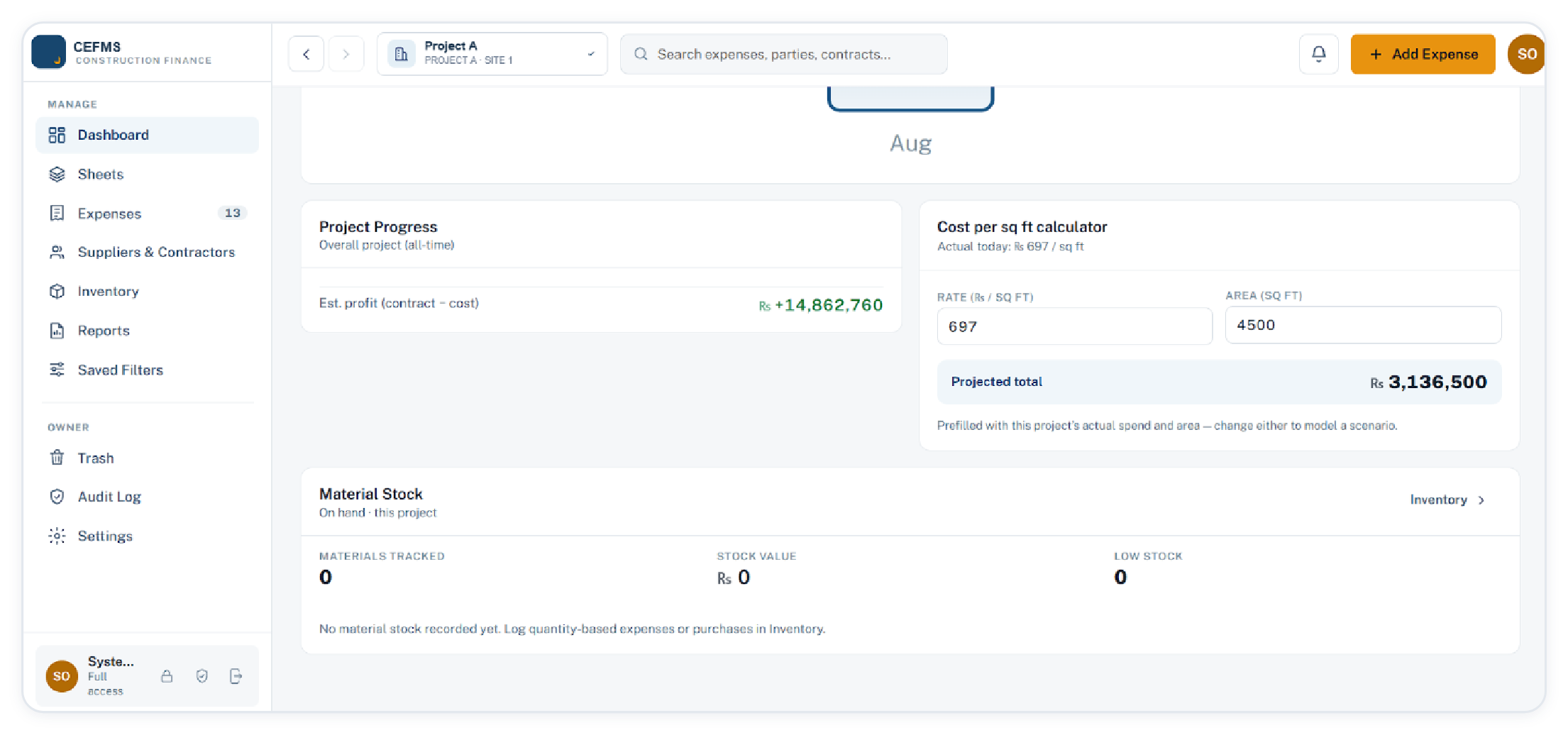
The lower half of the dashboard is for the estimating conversation: estimated profit against the contract value held on the project, and a cost per square foot calculator prefilled from its own spend and covered area, so a scenario can be modelled by changing one field.
The rate shown comes from real spend divided by real area, not from a quotation.
Contract value less cost booked to date, updated as entries arrive.
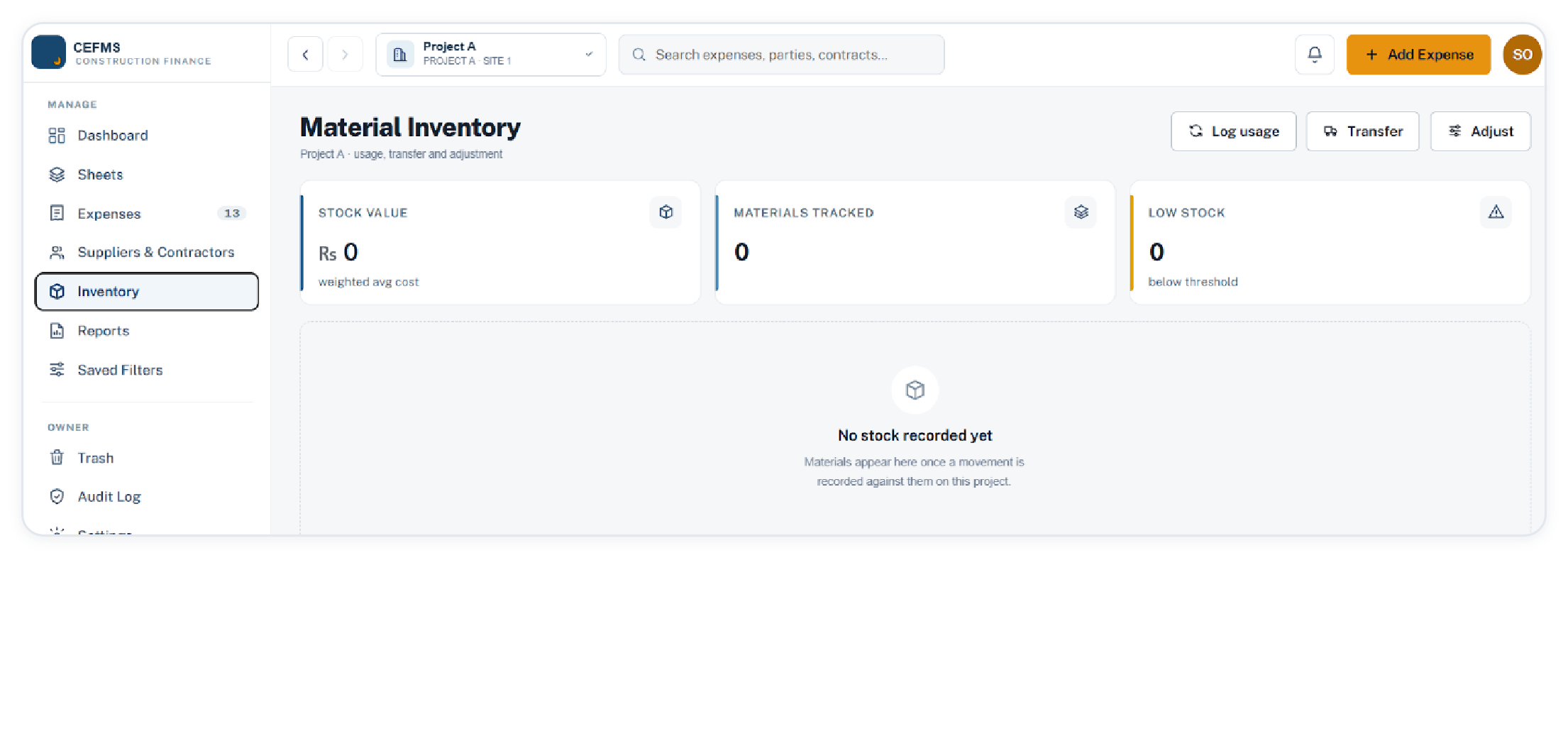
Materials tracked, stock value and low stock count for this project, read from the inventory ledger.
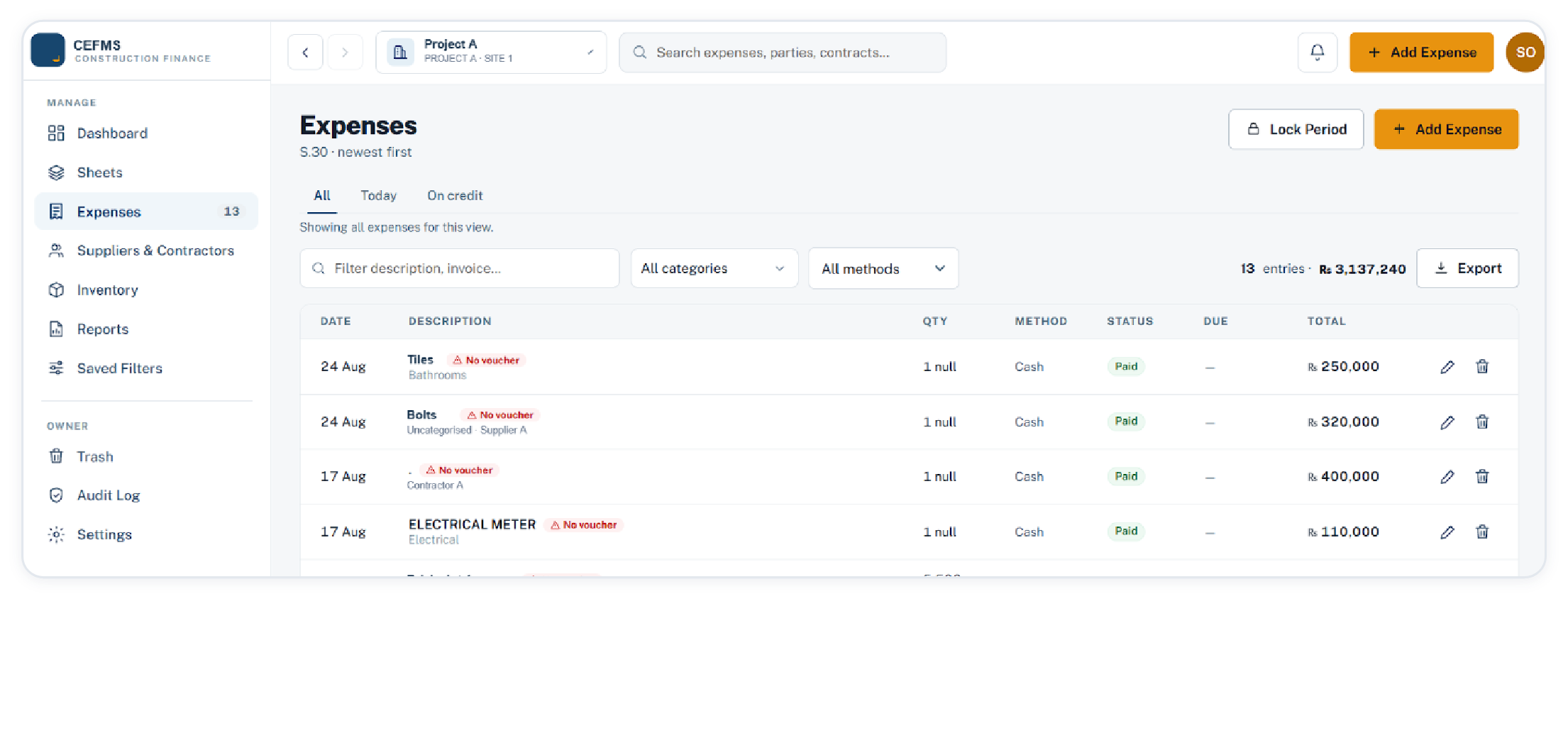
The list filters by description, invoice, category and payment method, shows entry count and value together, and flags rows with no voucher attached. Locking a period freezes the entries that exist up to that date for everyone except the owner.
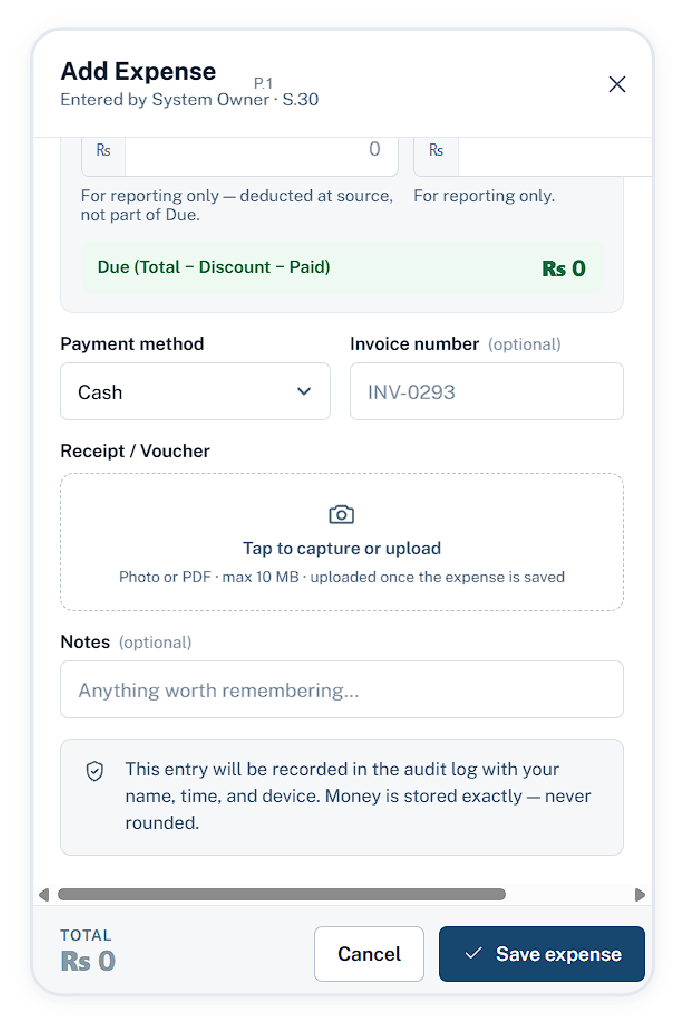
The total is computed and locked when a quantity and rate are given, and a lump-sum bill can be entered as a single figure. Discount and amount paid are separate fields, and the due amount is derived from total less discount less paid. Cash, bank, cheque and credit are the four methods. When the expense is created, what is owed and what was paid post to the party ledger as separate entries.
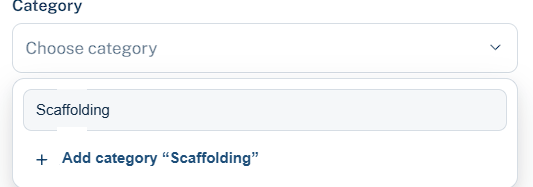
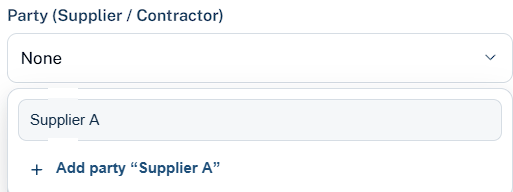
A missing category head or a new supplier is created from inside the form, so an unfamiliar name is never a reason to leave the entry for later.
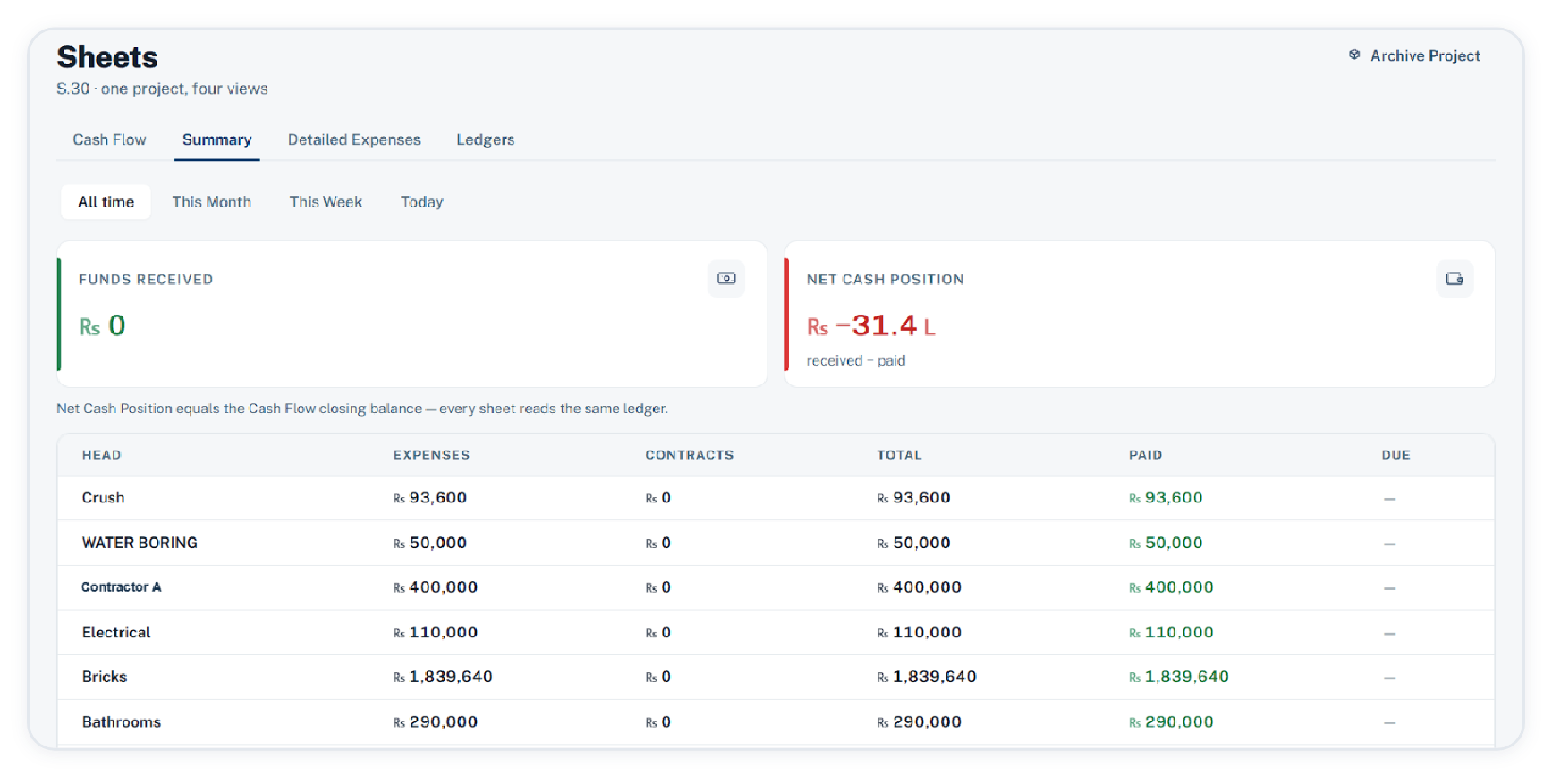
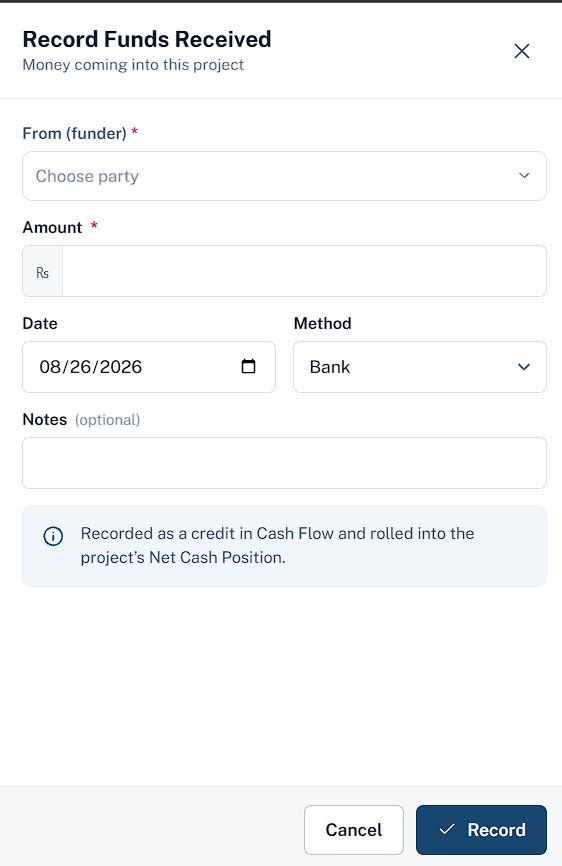
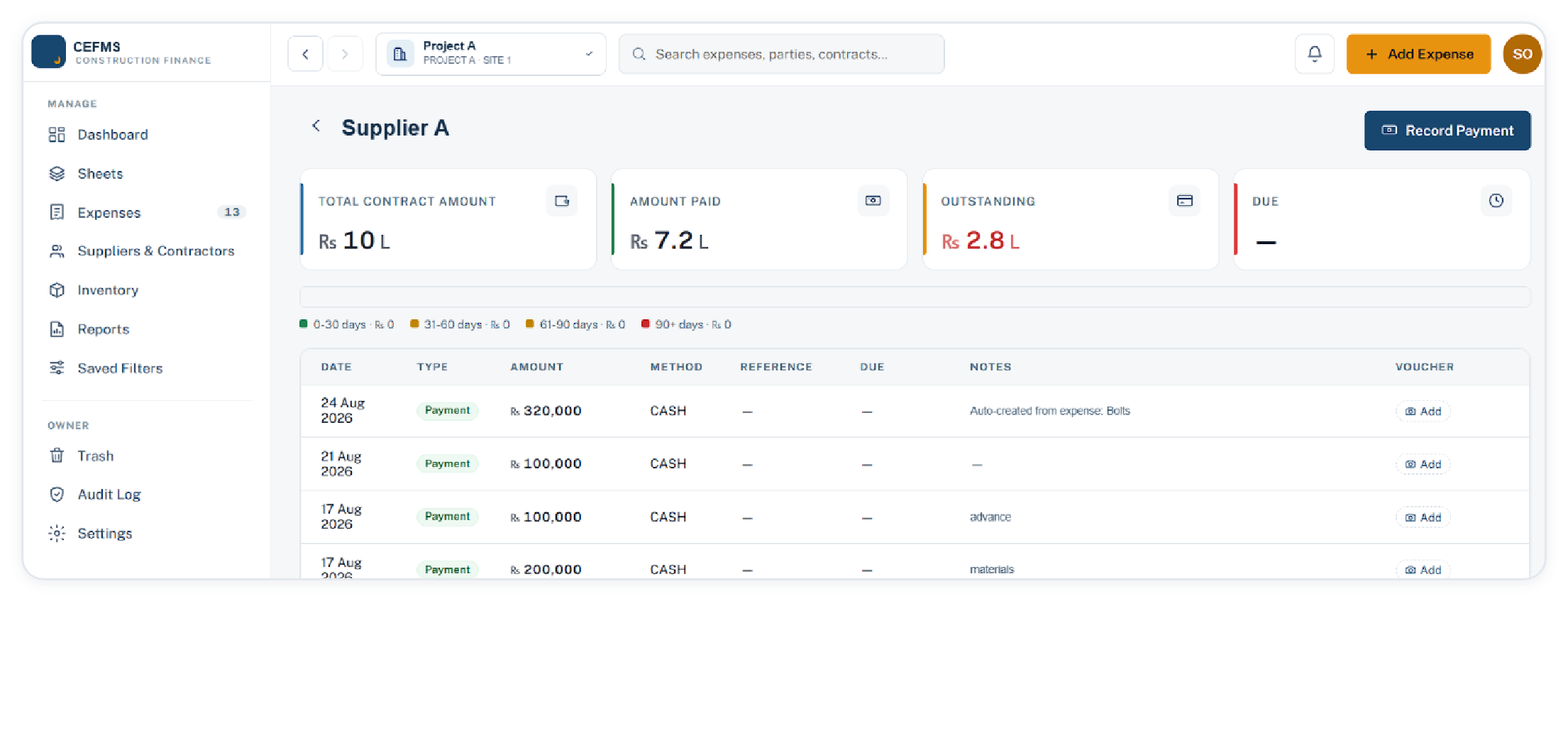
Cash flow, summary, detailed expenses and contract ledgers are tabs over the same records. Cash flow merges expenses, contract payments and funding into one running debit and credit ledger, with the opening balance entered on the report and a reconciled marker the owner or accountant can set.
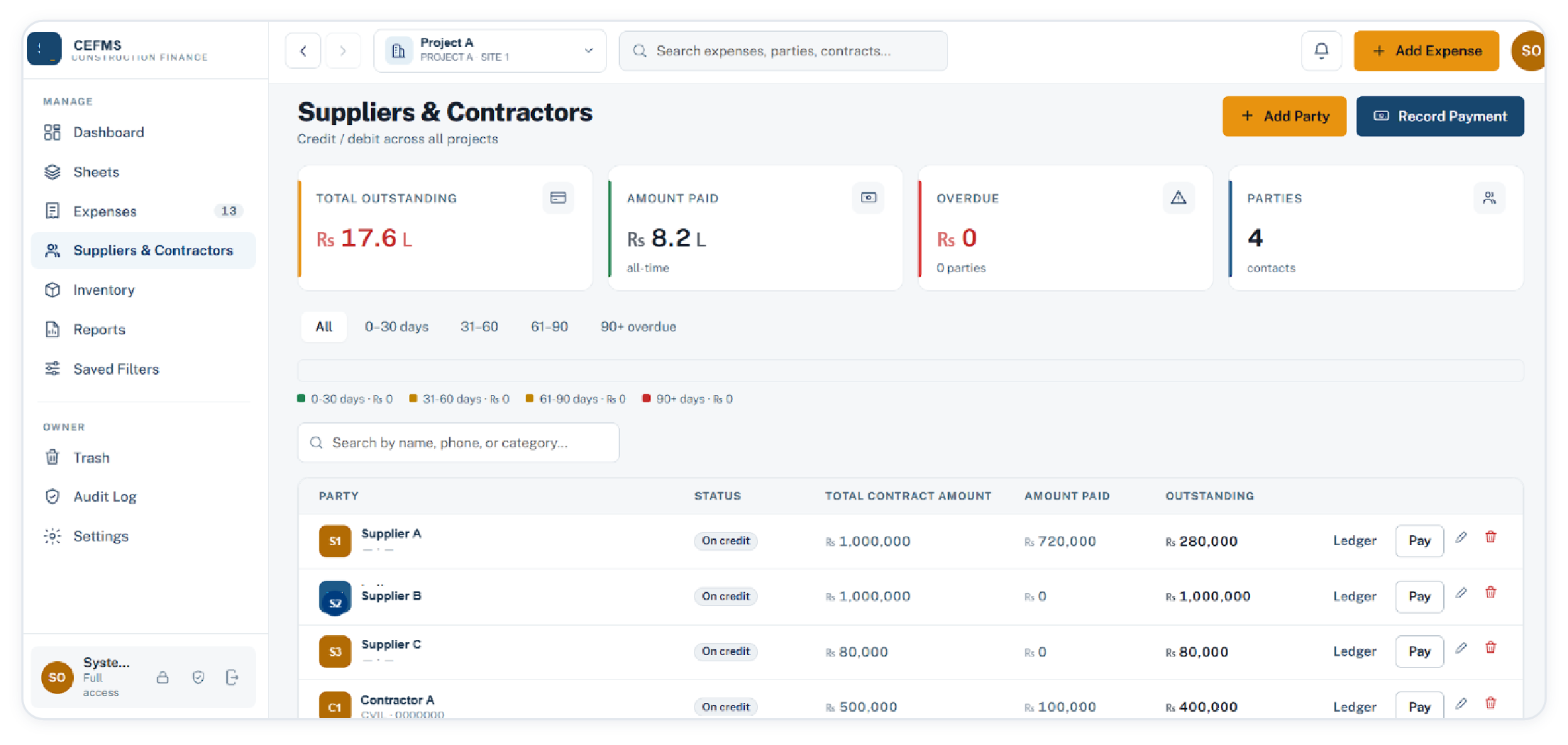
Credit and debit across all projects in one list: contract amount, paid, outstanding, and ageing by due date in 0 to 30, 31 to 60, 61 to 90 and 90 plus day buckets. Payment is recorded from the row itself.
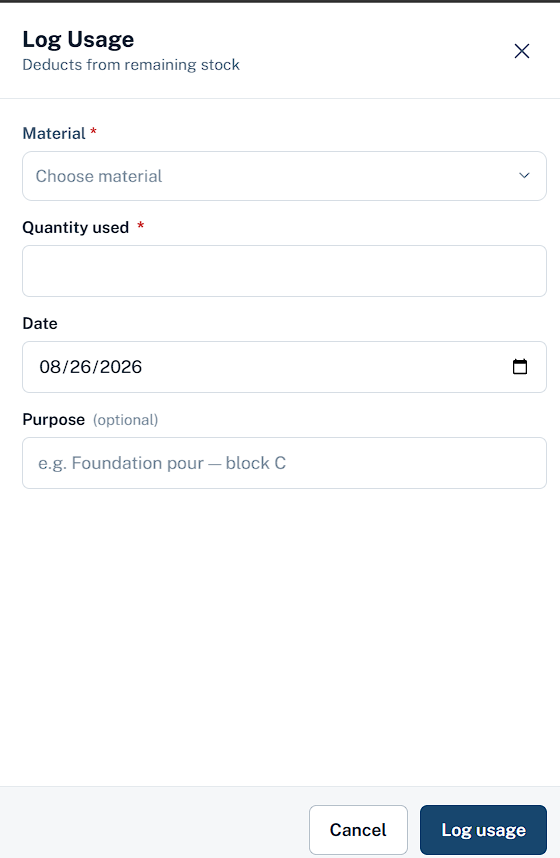
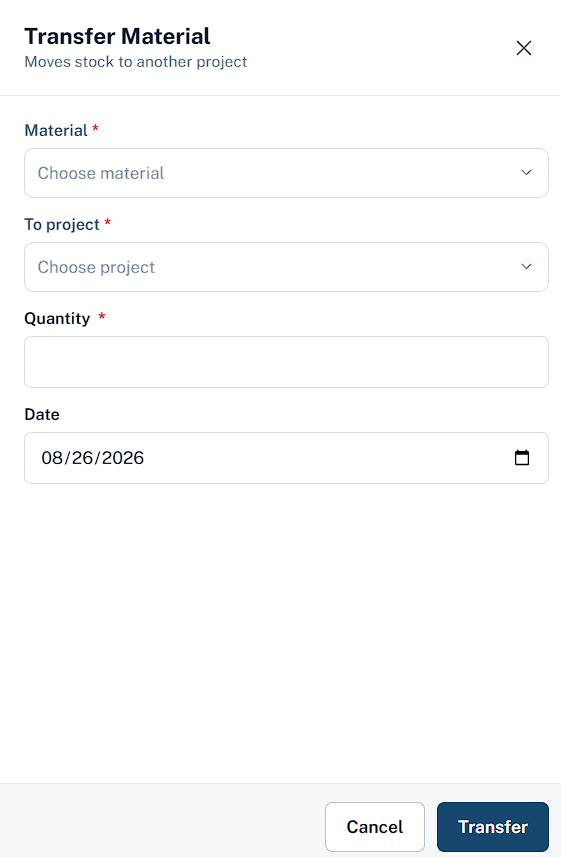
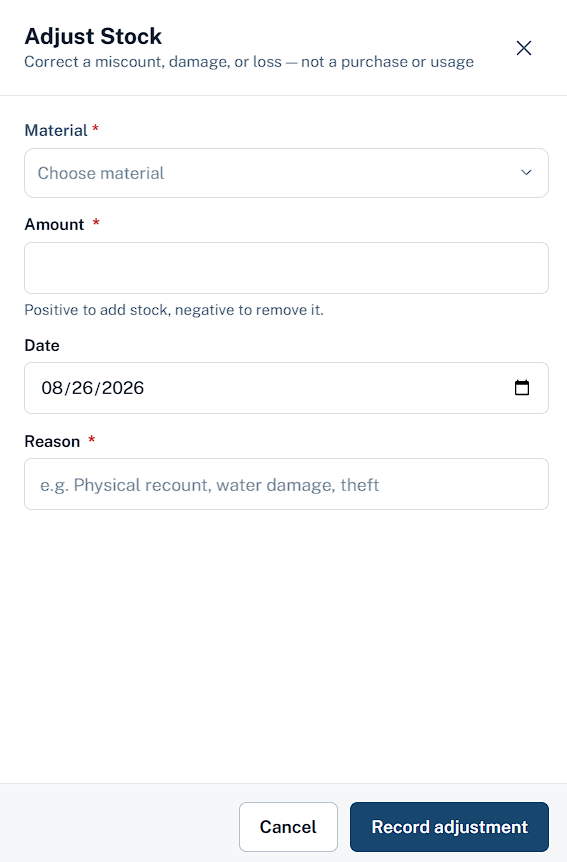
Stock is moved by hand: usage draws it down, transfers move it between projects, and adjustments correct or add it against a stated reason. Value is held at weighted average cost, recomputed by replaying the movement history rather than trusting a stored running total.
Deducts from remaining stock against a stated purpose. Quantity only: it moves no cost figure.
Moves stock to another project, valued at the source project’s current average cost.
Corrects a miscount, damage or loss against a stated reason, and is today the only way to add stock from the interface.
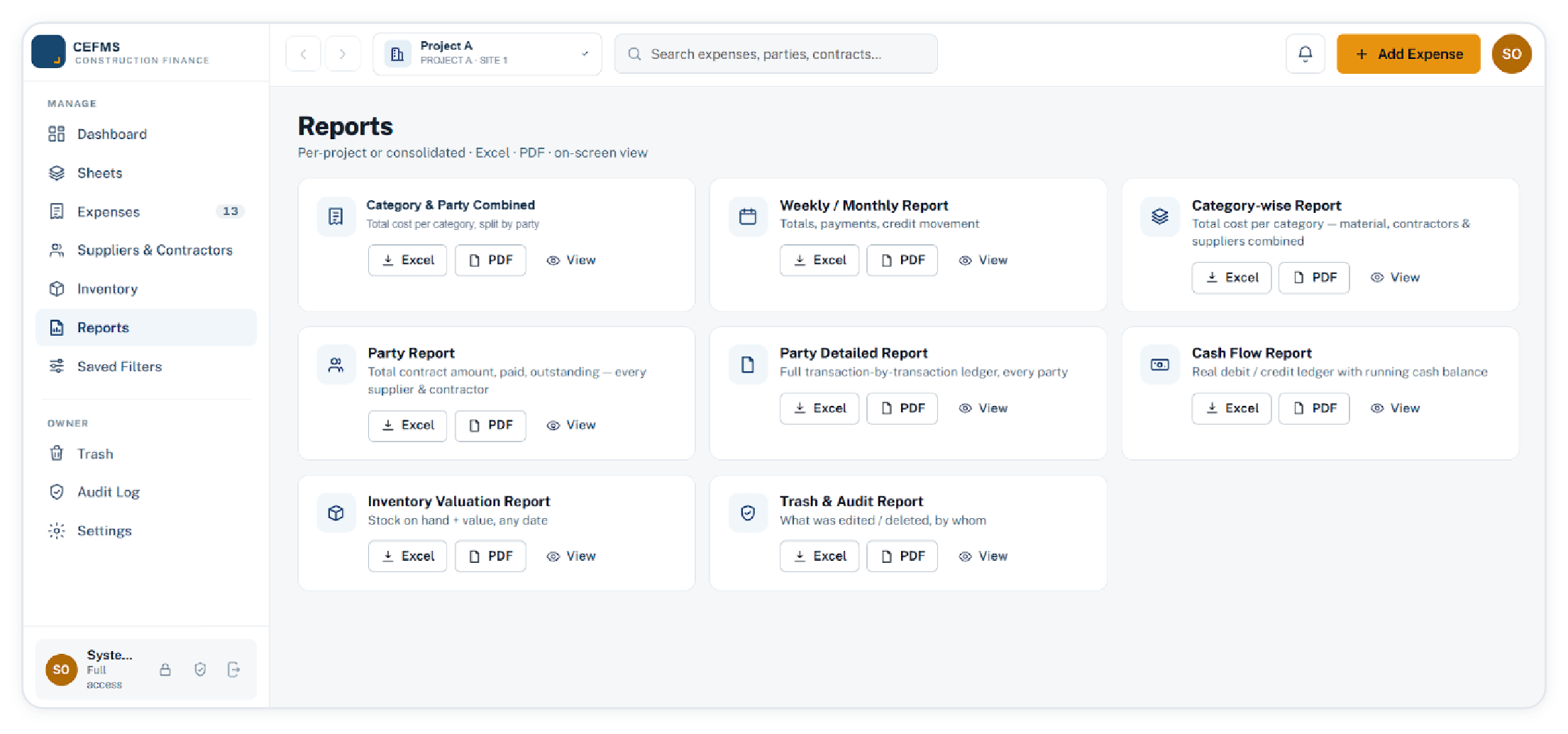
Per project or consolidated, each available as Excel, CSV or PDF, plus an on-screen view. These are the documents an accountant, a financier or a partner asks for, so they are generated rather than assembled by hand.
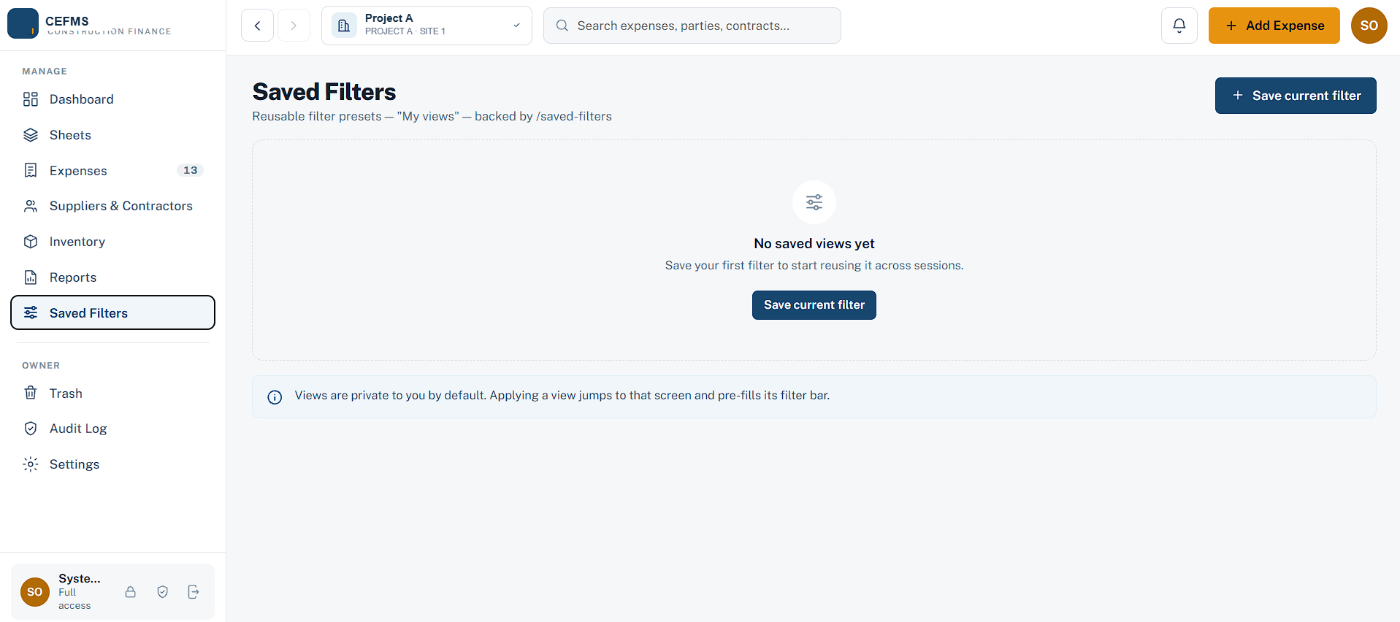
Saved filters turn a filter combination into a reusable view. Applying one jumps straight to that screen, and on Expenses it restores the saved filter values with it. Views are private to the user by default.
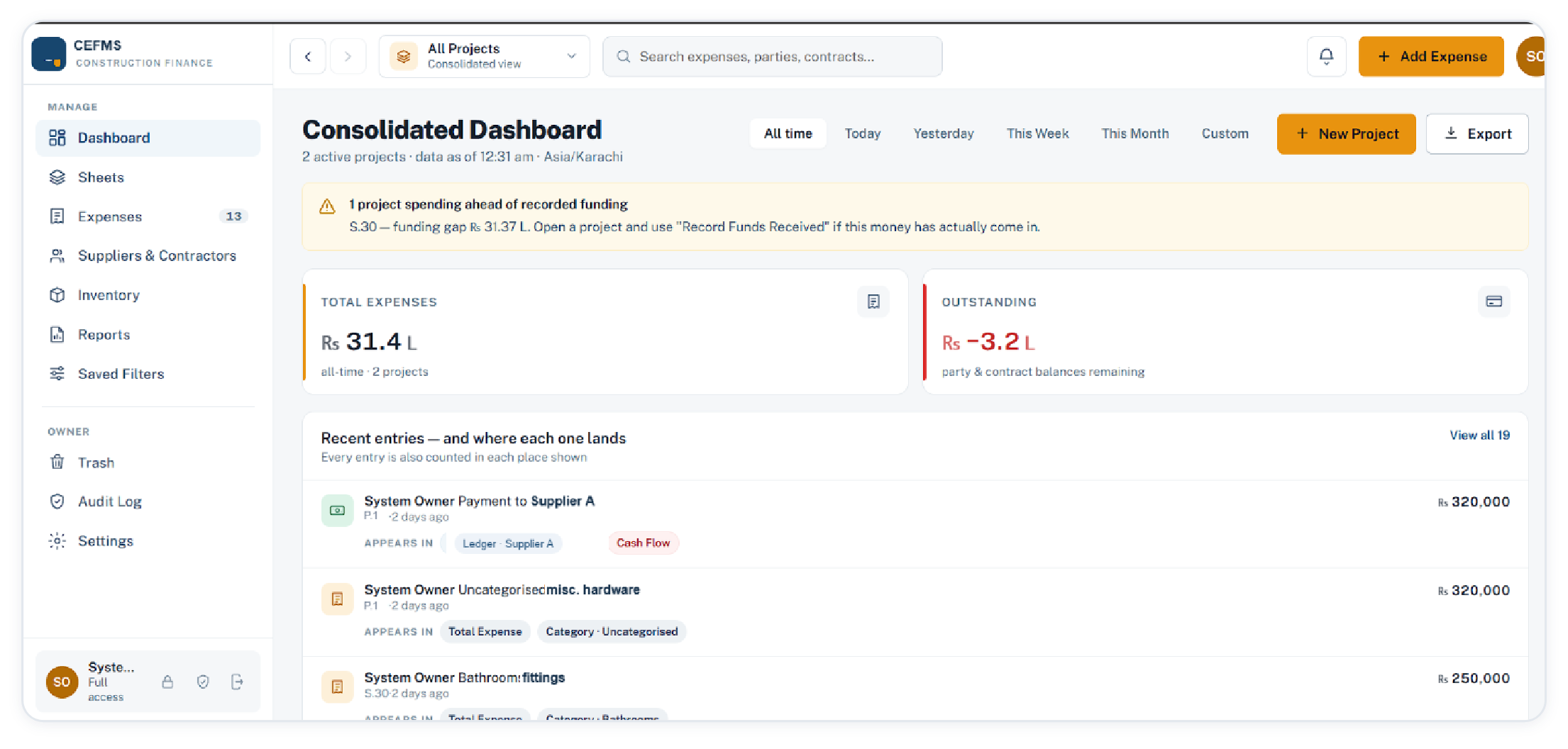
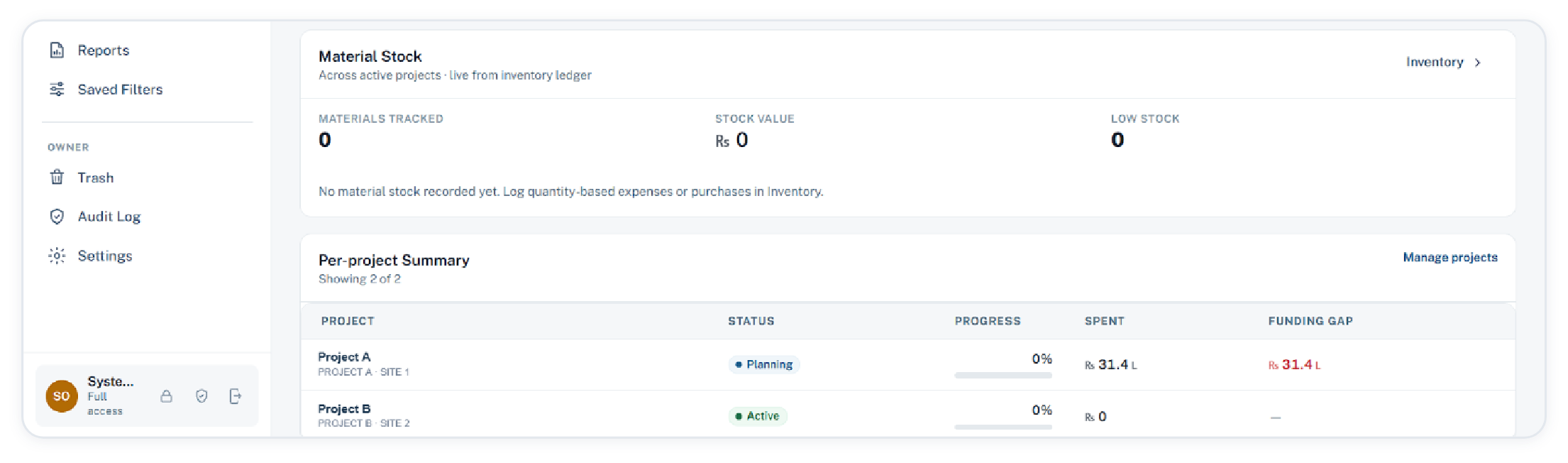
Switching to all projects consolidates the figures and raises the exception first: which project is spending ahead of recorded funding, and by how much. Each project keeps its own status, spend and funding gap.
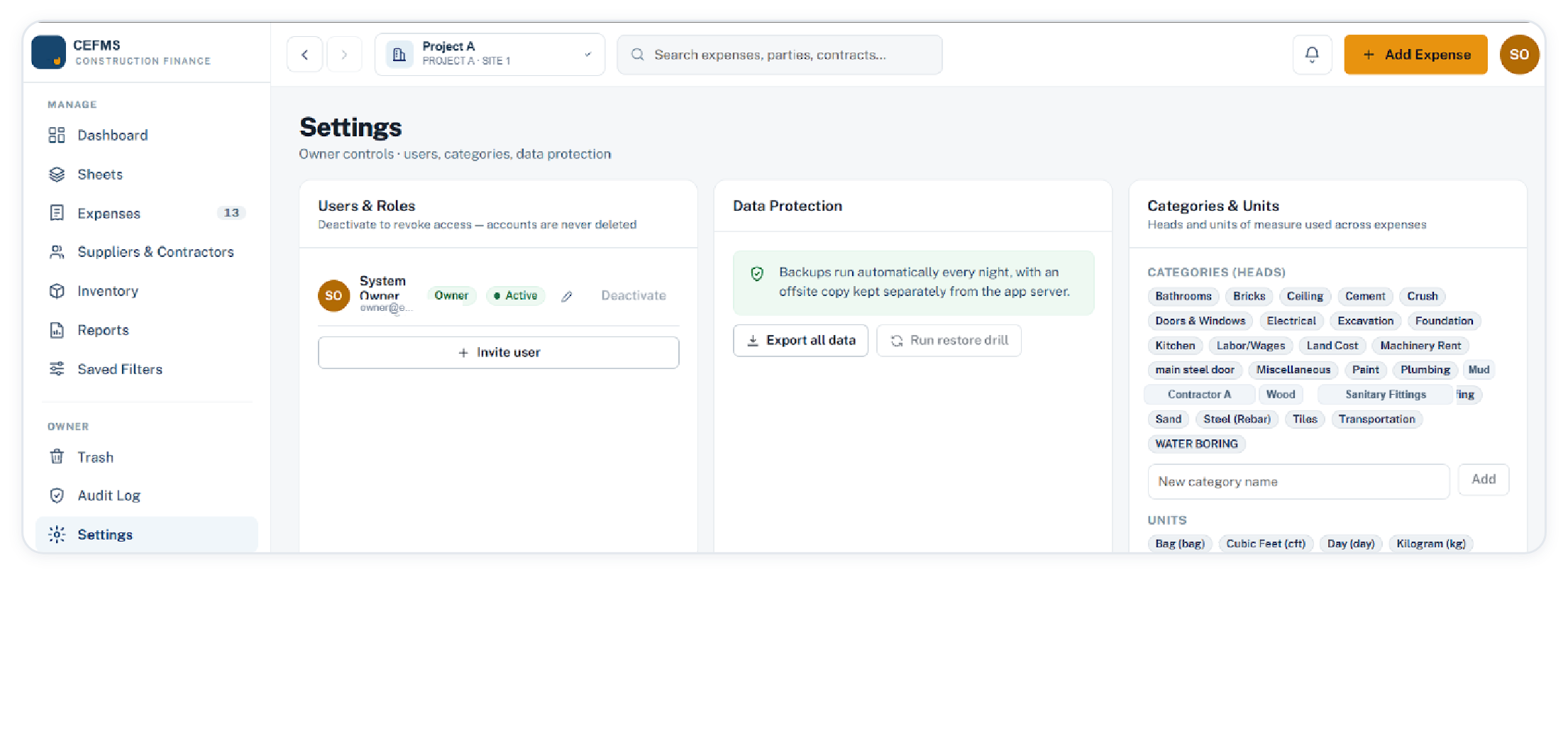
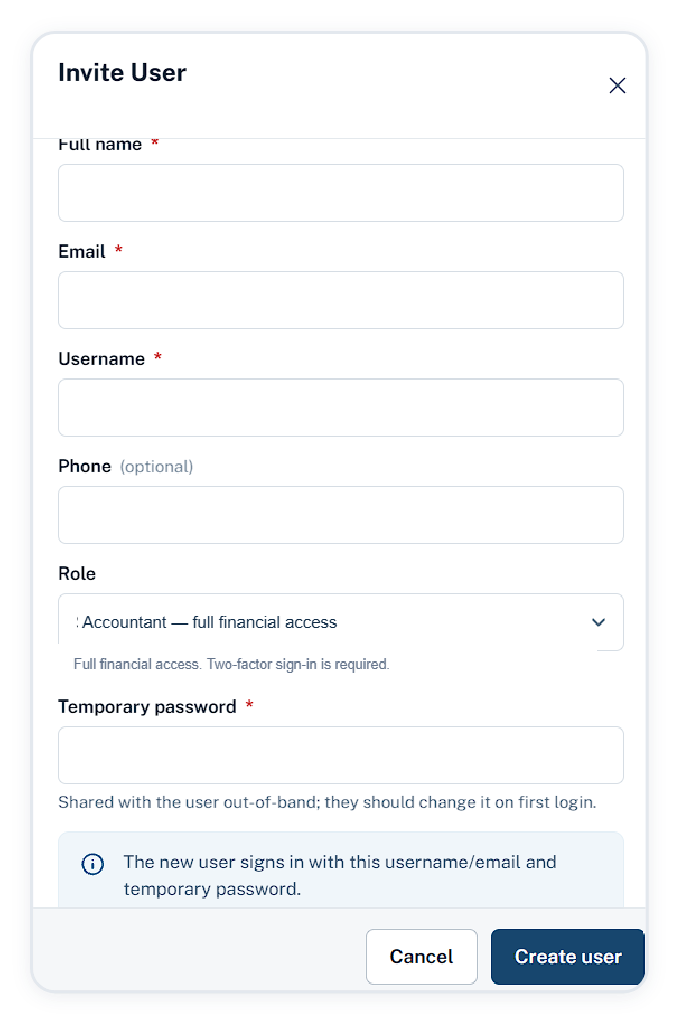
The owner invites users, assigns a role, and deactivates an account when someone leaves the site. Accounts are never deleted, because the entries they made must keep their author.
Everything in the walkthrough, plus trash, audit log and settings, which are owner-only screens.
The same financial reach as the owner across every project, with two-factor sign-in required.
Read access, and the one role that can be limited to named projects. Invited with a temporary password.
Two-factor authentication is mandatory for owner and accountant. Passwords run to fifteen characters and are checked against known breaches.
The audit log is append-only. Every create, edit, delete and login is stored with the user, the entity, the time, and the values before and after the change. The screen lists the actions; the values sit behind them in the record.
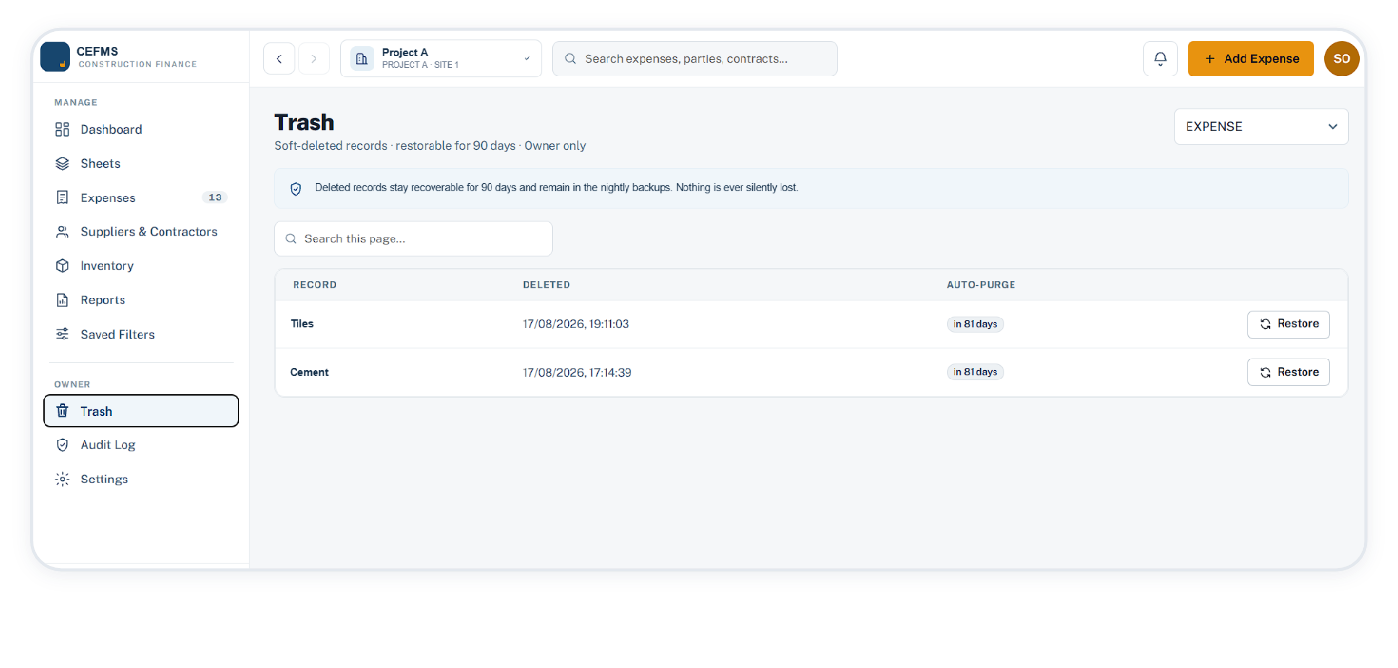
Deleted records are soft-deleted and restorable for 90 days, with the purge date shown on each row.
Backups run automatically every night, with an offsite copy kept separately from the app server. Deleted records remain in those backups. The owner can export the core business data as a zip of eleven tables with every receipt file. Restores are run by us, not from inside the app.
Amounts are stored exactly, never rounded. Locking a period protects the entries that already exist in it from everyone but the owner.
Everything below is in the working product today, and appears in the screens on the previous pages.
| Module | What it does | Output |
|---|---|---|
| Dashboard | Total spent, funded, cash in hand, funding-gap warning, spend by material or contractor or paid against owed, expense trend, project progress, cost per sq ft calculator | Screen, chart download |
| Expenses | Entry with quantity and rate or a lump sum, discount, paid and due, payment method, invoice number, voucher upload, notes; filters by description, category and method; no-voucher flag; period lock | Screen |
| Sheets | Cash flow merging expenses, contract payments and funding with a running balance and reconciliation marker; head-wise summary; detailed expenses; contract ledgers; funding entries | Screen, export |
| Suppliers & contractors | Contract amount, paid and outstanding per party across projects; ageing buckets to 90 plus days; payment recording; per-party transaction ledger with voucher slots | Screen, export |
| Inventory | Usage, transfer and adjustment movements valued at weighted average cost; per-material low-stock threshold; adjustments require a reason | Screen, valuation report |
| Reports | Weekly or monthly, category-wise, party, party detailed, category and party combined, cash flow, inventory valuation, trash and audit, per project or consolidated | Excel, CSV, PDF |
| Saved filters | Reusable filter presets that jump to a screen with its filter bar pre-filled, private to the user by default | Screen |
| Owner controls | Users and roles with deactivation, editable category heads and units, nightly offsite backups, full data export, 90-day trash, append-only audit log kept in full | Screen, export |
| Projects | Multiple projects with five statuses, a consolidated read-only view that drops archived projects from its totals, per-project summary with funding gap, global search over expenses, parties and contracts | Screen, export |
The product grows from the sites using it. Everything below is under evaluation rather than promised on a date, and nothing that ships is allowed to weaken the guarantees on the previous pages.
Reading a voucher photo to pre-fill the amount, party and quantity, so the site user confirms an entry instead of typing it. The entry would stay reviewable and editable before saving.
Asking for a figure in plain language, such as what bricks cost this month or which party is furthest overdue, and getting the number with the entries behind it.
Flagging a rate far from the recent average, or a duplicate voucher, as a prompt to look. Never an automatic correction.
Handover of the ledger to the accounting package a firm already uses, and richer exports for financiers.
A firm’s cost data is commercially sensitive. Assistance of this kind would be opt-in per project, visible in the audit log like any other action, and would not put your figures into anyone else’s hands. Where a feature cannot meet that bar, it does not ship.
Every screen in this document is from the working product, pre-launch and in daily use on one live project. Each firm that adopts it shapes what is built next.